Do you already own a flagpole that has deteriorated over the years? Did you know that it is often possible to repair it? We offer spare parts for our products (flagpoles and other supports), as well as parts compatible with several other models/brands of flagpoles.
Contact our team; they will ask you questions about the type of flagpole, its location, etc., to better understand your needs. Following this, we will be able to provide you with a detailed quote. You can perform the repair yourself or take advantage of our expert repair service.
For more information, please do not hesitate to contact our team; we will be happy to guide you through the process.
We are one of the few companies in Quebec that manufactures, repairs, installs and distributes flagpoles.
Committed to offering the highest quality, we use almost 98% Quebec-made materials, 100% of our suppliers are Quebec-based and almost 60% of our suppliers are within 15 km of our company.
This is one of the reasons why we are accepted on LEED Silver projects!
How do you choose the right type of flagpole? Several flagpole models are available; ground poles, wall mounts, and removable or fixed roof mounts. The choice of model will depend on the available space, the intended use, your preferences, and your budget.
Contact our team to learn more. We can present the different options to you. Furthermore, we have all our flagpole models in stock!
How do you choose the right type of flagpole? Several flagpole models are available; ground-mounted, wall-mounted, or even removable or fixed roof-mounted. The choice of model will depend on the available space, the intended use, your preferences, and your budget.
Contact our team to learn more. We can present the different options to you. Furthermore, we have all our flagpole models in stock!
How do you choose the right type of flagpole? Several flagpole models are available; ground-mounted, wall-mounted, or even removable or fixed roof-mounted. The choice of model will depend on the available space, the intended use, your preferences, and your budget.
Contact our team to learn more. We can present the different options to you. Furthermore, we have all our flagpole models in stock!
The vast majority of institutions under the jurisdiction of the Quebec government are required to display the Quebec flag. When displayed with other flags or emblems, it must occupy the place of honour and take precedence, in accordance with the general standards for the use of the national flag.
Here are some other rules to follow:
NOTE that its standards also apply to businesses and individuals
The practice of lowering the lights to half-mast is used during periods of mourning; this request may follow a municipal, provincial or federal request. The position of a flag flying at half-mast depends on its size, the height of the flagpole, and its location; but, as a general rule, the center of the flag should be exactly in the middle of the flagpole. When raising or lowering the flag, it must first be hoisted to the top of the flagpole.
Source: https://www.canada.ca/en/canadian-heritage/services/flag-canada-masting-rules.html
The mourning tie is used when the flag cannot be flown at half-mast on a flagpole. It is used on interior poles as well as 45D wall brackets. It is a black crepe fabric measuring 2,5 m long and 33 cm wide and attached in a loop at the base of the finial (decorative piece) so that the span of the loop is 30 cm. The ends of the fabric, cut at an angle of 45 degrees, will fall to the middle of the flag sleeve.
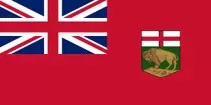 Signification of flag: Adopted in 1965 by decree of Queen Elizabeth II, it closely resembles the Canadian Red Ensign. The Royal Union Flag occupies the upper quarter near the hoist, while the provincial coat of arms is placed in the centre of the fly, the part furthest from it.
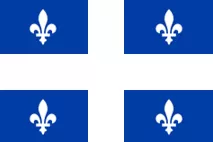 Signification of flag: The flag of Quebec was adopted in 1948 by order of the Lieutenant Governor in Council and sanctioned by the provincial legislature in 1950. The Quebec flag is commonly known as the fleur-de-lis flag. Its white cross on a blue field is reminiscent of an old French army banner, and the four fleurs-de-lis symbolize France.
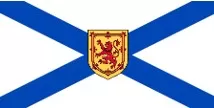 Signification of flag: King George V endorsed the flag of Nova Scotia in 1929. It was the first flag in the Commonwealth countries overseas to be granted by royal charter. The flag is based on the old coat of arms granted in 1625. The shield from the province's coat of arms is reproduced in a rectangular shape.
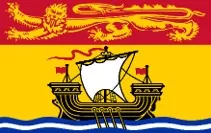 Signification of flag: Adopted by proclamation of Queen Victoria in 1965. The province takes its name from the Duchy of Brunswick, Germany, which in 1784, the year of the province's founding, was one of King George III's possessions. Since the Duchy of Brunswick's coat of arms consists of two gold leopards on a red field, and the King's coat of arms consists of three gold leopards of England, the gold leopard on the flag symbolizes the ties that bind New-Brunswick to the Duchy of Brunswick and England. The galley, a traditional heraldic representation of a ship, reflects the two main economic activities in New-Brunswick at the time the coat of arms was granted: shipping and shipbuilding.
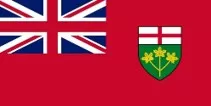 Signification of flag: The Legislature adopted the Ontario flag in 1965. That same year, Queen Elizabeth II approved the use of the Royal Union Flag (Union Jack). The flag was first raised on May 21, 1965. This flag closely resembles the Canadian Red Ensign. The Royal Union Flag occupies the upper quarter near the hoist, and the coat of arms is placed on the fly, in the centre of its farthest section.
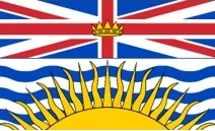 Signification of flag: Adopted by order of King Edward VII in 1906 and the flag was adopted by order of the Lieutenant Governor in Council. The flag, which incorporates the image of the province's coat of arms, was adopted by order of the Lieutenant Governor in Council in 1960.
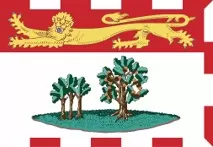 Signification of flag: Adopted by decree of King Edward VII in 1905 and officially sanctioned by law in 1964. The design is based on the province's coat of arms. Rectangular in shape, it is bordered on the three free-floating sides by alternating red and white bands.
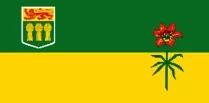 Signification of flag: Adopted by the Legislative Assembly and proclaimed by the Lieutenant Governor in 1969. It is divided horizontally into two equal parts, one green and the other gold. The green segment represents the forests of the northern part of the province, while the gold segment symbolizes the wheat fields of the south. The coat of arms of Saskatchewan occupies the upper quarter near the hoist, and the floral emblem, the red-orange lily, is placed vertically on the clapper. The design is based on a drawing by Anthony Drake, which won an award in a province-wide competition.
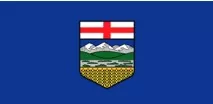 Signification of flag: First used in 1967 and officially authorized the following year. The flag bears in the center the shield of the province's coat of arms on an ultramarine blue field.
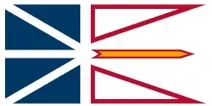 Signification of flag: The flag of Newfoundland and Labrador was designed by artist Christopher Pratt and was adopted by an Act of the Legislature passed in 1980. The white symbolizes snow and ice, the blue the sea, the red the labor of humankind, and the gold confidence in the future. The trident (depicted on the left of the flag) underscores the province's dependence on the sea and fishing. The two red triangles on the right represent the mainland and island parts of the province, and the gold arrow symbolizes hope for the future. When the flag is carried as a banner, the trident takes the form of a sword, a reminder of the sacrifices made in war.
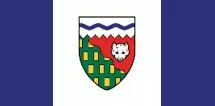 Signification of flag: The flag of the Northwest Territories was adopted by the Territorial Council in 1969 following a national competition; the winner was Robert Bessant of Margaret, Manitoba. The blue vertical stripes at both ends represent the lakes and waterways of the Territories. The white centre symbolizes the ice and snow of the North and features the shield from the Territories' coat of arms.
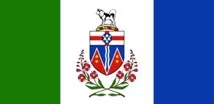 Signification of flag: The Yukon flag was sanctioned by a regulation of the Territorial Council in 1967. It is divided vertically into three panels. The panel along the hoist is green and symbolizes the Yukon forests, the white center panel represents the winter snows, and the blue fly panel represents the Yukon rivers and lakes. The center panel also bears the floral emblem, fireweed, and the Yukon coat of arms. The flag was designed by Lynn Lambert, a student from Haines Junction, who won the competition held for this purpose during Canada's centennial.
Source: https://www.canada.ca/en/canadian-heritage/services/provincial-territorial-symbols-canada/yukon.html
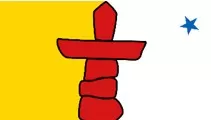 Signification of flag: The flag of Nunavut was granted by the Right Honourable Roméo LeBlanc, Governor General, on April 1, 1999. The colours, white, blue, and gold, symbolize the riches of the land, sea, and sky. The red represents Canada. As on the coat of arms, it features an inuksuk and the Niqirtsituk star.
Francophones in Canada: The majority of Francophones live in Quebec, but nearly one million are spread across the other provinces and territories of Canada. Since the second half of the 19th century, these Francophones in minority situations have come together within organizations, federations, and associations that work to foster the development of their communities. Over the years, Francophone communities in Canada have adopted emblems and flags, symbols of their pride and dynamism.
Source: www.canada.ca/en/canadian-heritage/services/francophonie-flags.html
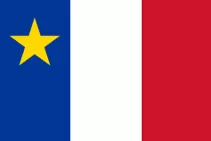 Signification of flag: The Acadian national flag was adopted in 1884 at the second Acadian National Convention held in Miscouche, Prince Edward Island. It represents the Acadians of Nova Scotia, New-Brunswick, and Prince Edward Island. The tricolour design is inspired by that of France, and the yellow star represents Our Lady of the Assumption, the patron saint of the Acadians.
Source: www.canada.ca/en/canadian-heritage/services/francophonie-flags.html#a11
 Signification of flag: The flag of Ontario’s Francophone community is green and white. These colours reflect the province’s diverse climate (green symbolizes summer, and white winter). The fleur-de-lis represents the global Francophonie, and the trillium is the official floral emblem of Ontario. This flag was officially unveiled in 1975 and officially adopted as the emblem of the Franco-Ontarian community by the Legislative Assembly of Ontario in 2001.
Source: www.canada.ca/en/canadian-heritage/services/francophonie-flags.html#a12
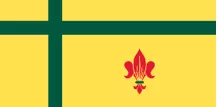 Signification of flag: The Fransaskois flag is in the colours of Saskatchewan and has represented the Francophone community since 1979. The yellow evokes the wheat fields, the green the pine forests, and the red, the colour of the heart, represents the Francophones of the province. The cross solemnly commemorates the missionaries who founded most of the first Francophone settlements in Saskatchewan, and the fleur-de-lis symbolizes the Francophonie.
Source: www.canada.ca/en/canadian-heritage/services/francophonie-flags.html#a13
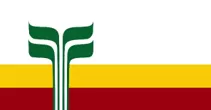 Signification of flag: The Franco-Manitoban flag features a red and a yellow stripe representing the Red River and Manitoba wheat. The green stem evokes deep roots that grow into a vibrant leaf in the shape of an "F," symbolizing Francophones. This flag was unveiled in 1980.
Source: www.canada.ca/en/canadian-heritage/services/francophonie-flags.html#a14
 Signification of the flag: The Franco-Colombian flag, adopted in 1982, features the floral emblem of British Columbia, the dogwood tree. The blue lines represent the sea, and the upward sweep of the lines evokes the Rocky Mountains. The fleur-de-lis symbolizes the Francophonie and points towards the sun, represented by the yellow disc.
Source: [www.canada.ca/en/canadian-heritage/services/francophonie-flags.html#a15]www.canada.ca/en/canadian-heritage/services/francophonie-flags.html#a15)
 Signification of flag: The Franco-Albertan flag, adopted in 1982, is blue, white, and red. The fleur-de-lis represents Francophone culture, the stylized wild rose and the blue represent Alberta, the white the global Francophone community, and the blue and white stripes the waterways and routes used by explorers and settlers.
Source: www.canada.ca/en/canadian-heritage/services/francophonie-flags.html#a16
 Signification of flag: The blue of the Yukon Francophone community flag represents the international Francophonie; the gold colour takes us back to 1898, the time of the Klondike Gold Rush; finally, the white evokes the snow that covers the Yukon landscape for much of the year. The flag was adopted in 1986.
Source: www.canada.ca/fr/patrimoine-canadien/services/drapeaux-francophonie.html#a17
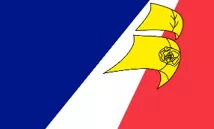 Signification of flag: The blue, white, and red flag of the Francophone community of Newfoundland and Labrador highlights its French origins. Its two yellow sails, the colour of Acadia, commemorate the arrival of their ancestors; the upper sail is decorated with a tamarack branch, the emblem of Labrador, and the main sail with a pitcher plant, the floral emblem of the province. The flag was adopted in 1986 and first raised in 1987.
Source: www.canada.ca/en/canadian-heritage/services/francophonie-flags.html#a18
 Signification of flag: The flag of the Francophone community of the Northwest Territories depicts a curve on which a bear stands. The white represents snow, and the blue represents the Francophonie. The curve evokes the 60th parallel, beyond which lie the Northwest Territories, near the North Pole. The polar bear, a symbol of freedom and the vast northern wilderness, gazes at the snowflake and the fleur-de-lis, a symbol of the Francophone community in the North. Its flag was adopted in 1992.
Source: www.canada.ca/fr/patrimoine-canadien/services/drapeaux-francophonie.html#a19
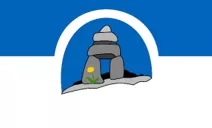 Signification of flag: In the Franco-Nunavut flag, adopted in 1981, blue represents the Arctic sky, and white represents the snow. The central shape evokes an igloo and contains an inuksuk (a stone mound symbolizing human presence in this vast territory). The dandelion at the base of the inuksuk represents the Francophone community of Canada and Nunavut: tenacious and persevering, it withstands adversity, adapts to its environment, and adds its colours.
Source: www.canada.ca/fr/patrimoine-canadien/services/drapeaux-francophonie.html#a110
The term “Francophonie” was first used at the end of the 19th century to refer to countries under France’s influence. Today, it refers to the community of peoples around the world who speak or use French to varying degrees in their own countries or internationally.
La Francophonie also describes an international network of more than 60 states and governments that share the use of the French language. Recognizing the importance of the French language and culture at home and abroad, the Government of Canada has associated itself with La Francophonie from its beginning in 1970. Through this multilateral forum of cooperation and dialogue, Canada extends its considerable influence to promote the values that matter most to Canadians, namely:
Canada is a member in La Francophonie, while the provinces of Quebec and New Brunswick are recognized as participating governments. The flags of Canada, Quebec and New Brunswick officially represent the Canadian Francophonie. The circular form of the flag of La Francophonie conveys the idea of coming together. The five interconnected segments represent the idea of cooperation across the five continents where the members of La Francophonie are located. The five colours represent the various colours found on the flags of the participating countries and governments.
TECNIMA VL IS ONE OF THE LARGEST COMPANIES IN CANADA -
MANUFACTURED, REPAIRED, INSTALLED AND DISTRIBUTED - FLAGPOLES!

Phone: 450 799-3664
Toll free : 1 888 430-2534
Email: info@tecnima.net